Today is an historic day. It is the results day of the last year of Leaving Certificate exams which were accessible to all students - to those attending recognised state schools and to those outside the state school system, the repeat students, the external candidates, the one-subject students and the homeschooled students.
Approximately 3000 external students take Leaving Certificate exams every year. Some sit six exams or more and others may sit just one or two subjects. Many of these students will have studied for their exams entirely at home, with the help of a parent, a tutor or online resources. They register to sit the exams at a convenient school, and receive an exam number from the State Examinations Commission. In June, they go to their chosen school, sit their exams and then receive their results in August along with the 60,000+ other LC students across the country.
There are projects associated with some subjects i.e. Geography, Construction etc. Most external candidates opt not to sit exams in these subjects - there have always been a wide selection of subjects to choose from which do not have a project element.
Under the new Senior Cycle reforms, this relatively straightforward process has been abolished. Additional Assessment Components (AACs) have been introduced, with all subjects destined to have an AAC by 2029. An AAC is essentially a project: it must be completed in a classroom setting under the supervision of a teacher, typically taking up at least 20 hours of classroom time. When it is submitted to the State Examinations Commission, it must be authenticated by the teacher and the school principal. There are no exceptions to this process.
This essentially means that school attendance is now compulsory if you wish to access the Leaving Certificate. This obligation conflicts sharply with the constitutional right to home educate and has left many out-of-school learners hugely concerned. Any student who does not attend a recognised secondary school is now, in effect, excluded from the Leaving Certificate.
This is not the first time that the State has attempted to exclude home-educated and out-of-school learners from the Leaving Certificate. In 2020, home-educated Leaving Certificate student Elijah Burke took legal action against the Minister for Education as he had been excluded from receiving Calculated Grades - the grading process introduced during the Lockdown to replace regular Leaving Certificate exams. His educational circumstances did not fit within the assessment process designed for mainstream schools. In 2022, the Supreme Court ruled that the exclusion of home schooled students from the Calculated Grades process unlawfully interfered with their constitutional rights. The Court recognised that students educated outside the mainstream school system were entitled to have their interests properly considered when educational policy affecting access to third-level education was being developed and implemented. Specifically, the judgment outlined that the State must ensure that access arrangements for the Leaving Certificate do not unfairly disadvantage particular groups of students.
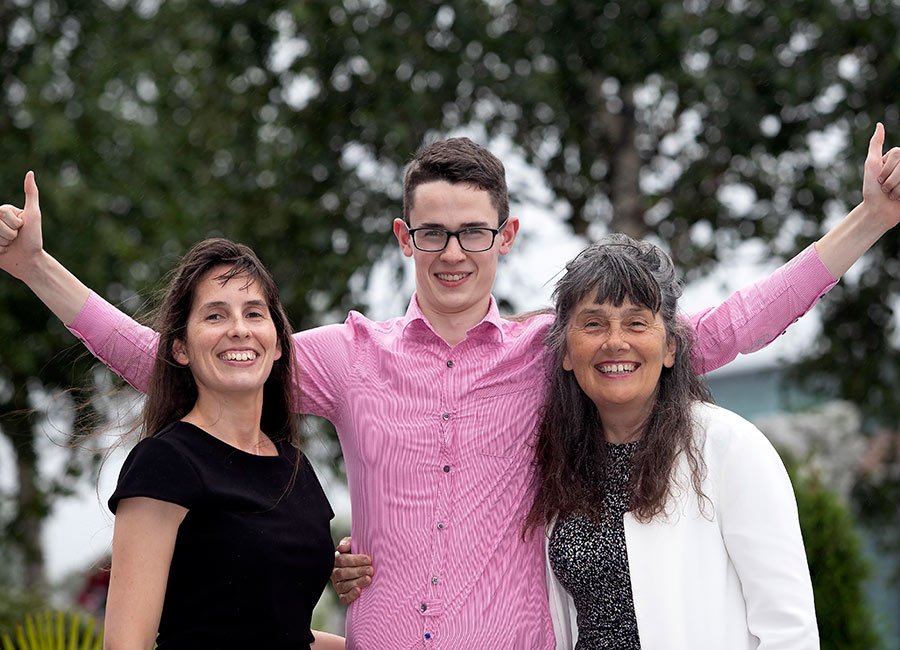
Elijah with his mother Martina and sister Esther in August 2020 after legal success
The State does not appear to have taken this significant Supreme Court ruling into account during the process of Senior Cycle Reform. An FOI submitted by Home Education Rights Ireland in June 2025 revealed that there was not a single reference to home education or out-of-school learners recorded during discussions, consultations and correspondence regarding Senior Cycle Reform. It is unacceptable that the State seems to consider itself above the law and the Constitution in this regard.
Home Education Rights Ireland has been raising this serious issue of exclusion with the Department of Education since February 2025. After months of silence, the only response we have received from Minister for Education Hildegarde Naughton is that home-schooled students and out-of-school learners may be able to make arrangements with a recognised school to fulfil the requirements for the submission of valid coursework for assessment.
What does this mean? Firstly it means that home-educated students and out-of-school learners will be forced to attend school. This is wrong because parents/guardians have a constitutional right to educate at home; furthermore Article 42.3 states that 'The State shall not oblige parents in violation of their conscience and lawful preference to send their children to schools established by the State'. However, under the Guidelines for the new reformed Leaving Certificate, the parents of any home-educated child who wishes to access the Leaving Certificate, will be now obliged to send that child to school - a clear contravention of a constitutional right.
Secondly, home-educated and out-of-school learners have been thrown completely on the goodwill of 'recognised' schools. Many schools are already struggling with facilitating their own students in completing the AACs and are very unlikely to take on external students for extended classroom contact. If an external student cannot find a school willing to facilitate them, they have no option but to forfeit up to 40% of their possible LC marks in that subject. This is a dereliction of the State's duty to not only acknowledge constitutional rights but to protect and uphold them. Home-educated students need a fair, accessible and equitable pathway to complete the Leaving Certificate.
Today, as the class of 2026 are celebrated, we are acutely aware that the joy of achievement experienced by so many is now being put out of the reach of a growing group of young people - those who do not attend 'recognised' schools. Statistics from the ESRI show that the percentage of students chronically absent from school is substantial and increasing – in many schools over 25%; almost 30% of secondary school students report extreme anxiety or major stress, with much of this related to school. For many young people, mainstream school is not an option - they simply do not ‘fit in’; others suffer with crippling school anxiety, and yet others have health or lifestyle needs which make alternative education a better choice for them. The State seems intent on closing the door, in defiance of the Constitution, to home education - the only hope for many of these young people and their families.
That the complete senior cycle system could be radically overhauled without taking the position of these young people into account is seriously wrong. What is even more galling is the fact that, despite the crystal clear Burke v Minister for Education ruling, the State continues to trample on the constitutional right to home educate. It is wrong that this issue may once again have be forced into the courts at immense cost to the taxpayer.