Unlike most European countries, Ireland has never adopted a restrictive legislative approach to home education. Since its establishment, the Irish State has always afforded home education a protected space. The Irish Constitution, which was enacted in 1937 under Éamon de Valera, explicitly recognises the Family as the “primary and natural educator of the child” and prohibits the State from forcing parents to send their children to State-designated schools [1].
Over the past century, the Irish courts have continuously upheld the constitutional right of parents to teach their children at home. Most of these cases have revolved around the interpretation of the ‘certain minimum’ of education which parents are obliged to give their children [2].
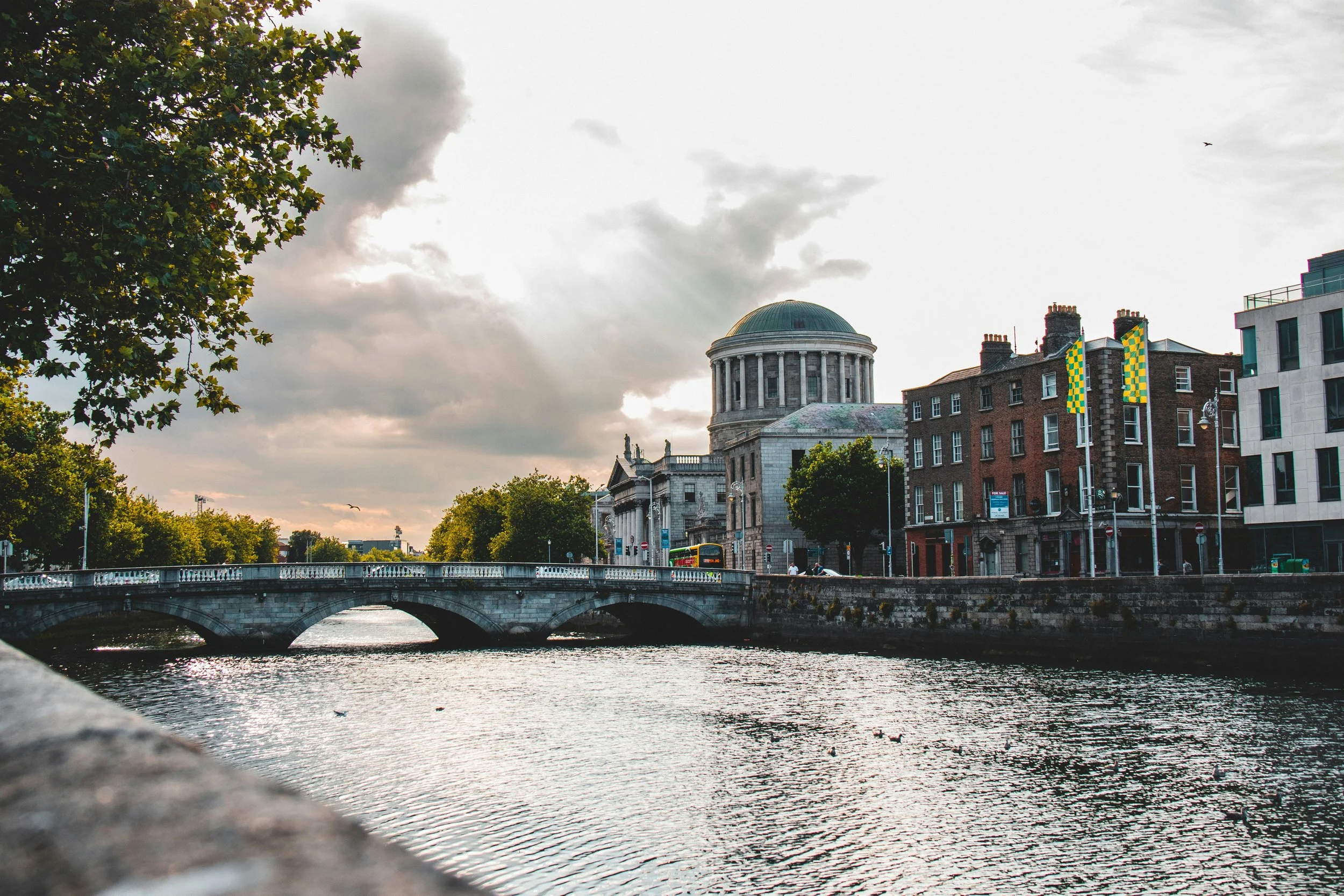
Four Courts, Inns Quay, Dublin
School Attendance Bill, 1942
In 1942, the Irish government attempted to pass an Act which would mandate all children to attend a recognised school unless otherwise validated by the Minister for Education. Section 4 of the School Attendance Bill, 1942 [3] stated:
“A child shall not be deemed for the purposes of this Act to be receiving suitable education in a manner other than by attending a national school, a suitable school, or a recognised school unless such education and the manner in which such child is receiving it have been certified under this section by the Minister to be suitable.”
The then President of Ireland – Douglas Hyde – used Article 26 of the Irish Constitution to refer the bill to the Irish Supreme Court to review its constitutionality. Upon review, the Court ruled that Section 4 was repugnant to the Constitution because it infringed on parents’ rights to educate their children as they saw fit:
“Under sub-s. 1 not only the education, but also the manner in which such child is receiving it must be certified by the Minister. We do not consider that this is warranted by the Constitution. The State is entitled to require that children shall receive a certain minimum education. So long as parents supply this general standard of education we are of opinion that the manner in which it is being given and received is entirely a matter for the parents and is not a matter in respect of which the State under the Constitution is entitled to interfere.”
DPP v Best
In the more recent case of DPP v Best [2000] Christine Best, a mother from Kerry, took two of her children out of a local primary school and began to educate both at home. At a hearing in the District Court at Listowel Kerry on 23 July 1997, Ms Best was charged for refusing to send her children to school. The presiding District Court judge – Ms. Justice Mary O’Halloran – referred the case to the High Court to determine whether she was prevented from convicting Ms Best given that the Irish Legislature had not yet defined what a certain minimum education consisted of.
On 31 July 1998, the High Court ruled that the District Court Judge could not convict Ms Best of the crime charged since the legislature had provided no clear definition for a ‘certain minimum education’ [4]. On appeal, the Supreme Court reversed this decision and held that a District Court Judge could decide, on the balance of probabilities, whether or not a suitable standard of education was being provided [5].
The following year, in 2000, the Irish Legislature (the Oireachtas) finally intervened and provided a clear framework for the registration of children receiving education outside of the state school system. Section 14 of the Act requires parents to register home educated children with the relevant state body (TUSLA – the Child and Family Agency).
Form R1
In December 2016, a home-educating family in Ireland sought to register their eldest child as ‘homeschooled’ with the Child and Family Agency (TUSLA). They were then contacted by TUSLA, which required them to fill out an application Form R1 before an assessment could be made. The parents refused to complete this form and were subsequently convicted by a District Court judge in 2018. On appeal, the Circuit Court held that parents who decide to home educate their children are not obliged to complete Form R1 when registering their children with TUSLA and held that the School Attendance Notice issued was invalid.
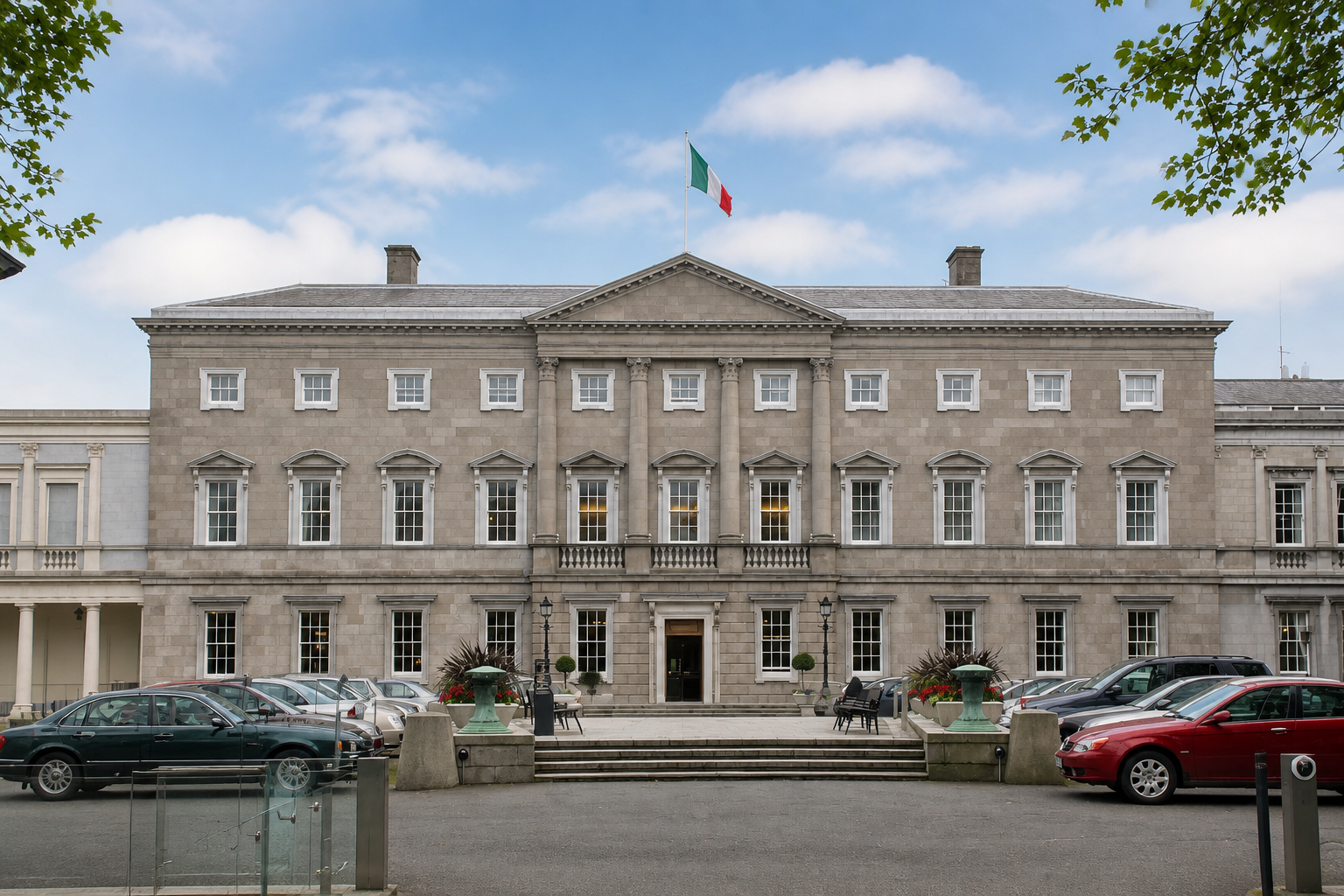
Leinster House, Kildare Street, Dublin
The Irish government unfortunately responded to this Circuit Court ruling by introducing a statutory instrument in 2020 which legalised the mandatory use of the Form R1 for parents who wish to place their children on the home education register. Moreover, an additional statutory instrument (enacted in 2024) provides that assessors will now communicate directly with the child to ascertain their views during all education assessments undertaken [6].
Burke v Minister for Education
In 2020, home-educated student Elijah Burke was preparing to sit the 2020 Leaving Certificate examinations. However, in May 2020, the Irish Government cancelled the Leaving Certificate and introduced the Calculated Grades Scheme. This scheme was a temporary grading system which used teacher estimates and school data to award Leaving Certificate results.
Although the system provided exceptions for public school students taught by their parents, it offered no such accommodation for home-schooled students. Consequently, despite being taught his entire life by his mother – a registered teacher – Burke was excluded from the Calculated Grades Scheme. This effectively meant that Mr Burke was obliged to wait until November to sit the Leaving Cert. This would delay his progress to third level by a full year.
In its ruling, the Irish Supreme Court unanimously agreed that the blanket exclusion of home-schooled students from the calculated grades process was an unconstitutional infringement of parent’s right to home educate their children under Article 42 of the Irish Constitution. In his judgment, Charleton J stated:
“a right to home-school is not undermined by changes in policy once a path to university or third-level remains open on a reasonably equitable basis and once the changes occur over time, enabling adaptation. […]
“[T]he Department of Education inadvertently exceeded the jurisdictional limits of the Constitution by leaving the home-schooled with no available entry to third level approximating to that open to school students.” [7]
Effectively, the Burke judgment held that nation-wide assessments conducted by the Irish state cannot preclude home-schooled children from entering third level. In other words, the Department of Education cannot implement educational frameworks that completely deny home-educated pupils a viable path to third-level education.
Challenges
While the constitutional right to home educate has long been vindicated, it requires continual vigilance. In particular, the right to home educate faces two main challenges. First, the recent statutory instruments which amend the Education Welfare Act 2000 undoubtedly represent an attempt by the state to exercise much more rigorous and perhaps invasive supervision of families which choose to practice home education.
Second, the revised Senior Cycle presents a grave challenge to home-educated learners who are seeking entry into third level education through standard state assessment pathways. The new Senior Cycle will be assessed in each subject by a written end-of-year exam (60%) and an additional assessment component (40%), which is to be completed under the supervision of teachers in school in order to facilitate authentication. There have been no workarounds established for home educated students and out-of-school learners who have no access to project authentication by a teacher. This represents a serious failure by the State to provide for the rights of parents to home educate.
Conclusion
To conclude, the Irish Constitution provides a robust foundation for the right of parents to home educate. Moreover, throughout the past century, this right has been interpreted favourably by the Irish courts, safeguarding it from unwarranted state intrusion. Parents are entitled to educate their children as they see fit without undue and excessive state oversight.
Unfortunately, despite this historical trajectory, the past decade has witnessed a marked escalation in the regulation of the right to home educate. Consequently, it is more important than ever, that parents are aware of their legal rights and obligations in order to ensure that this vital right endures for future generations.
[1] Article 42, Bunreacht na hÉireann.
[2] Ibid.
[3] In re Article 26 of the Constitution and the School Attendance Bill, 1942 [1943] I.R. 334
[4] Director of Public Prosecutions v Best [1998] IEHC 132.
[5] Director of Public Prosecutions v Best [2000] 2 IR 17.
[6] Education (Welfare) Act 2000 (Prescribed Form) (Section 14) (Amendment) Regulations 2024, SI 2024/758.
[7] Burke v Minister for Education and Skills [2022] IESC 1 (Charleton J [46-47])